
49.00 $ Mind Vault – AI-Powered Memory App to Never Forget Anything Again: Full Review Houston
- Location: Houston, Texas, United States
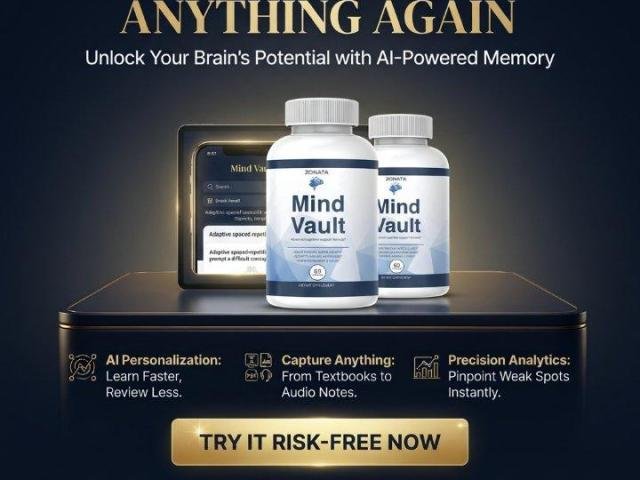
You know that feeling. You're three weeks into a new course, cramming for a certification exam, or trying to remember a client's name at a networking event, and the information just… evaporates. You studied it. You highlighted it. You even made notes. But when it's time to recall, your brain goes blank.
That's the problem Mind Vault is built to solve. This AI-powered memory app uses adaptive algorithms to turn what you want to remember into a personalized retention system. Instead of rereading the same paragraph five times, the app decides when and how to show you information so it sticks in long-term memory.
I've spent time testing Mind Vault alongside traditional study methods—plain flashcards, handwritten notes, and basic spaced-repetition tools—to see whether the AI layer actually changes the outcome or just adds a fancy interface on top of the same old drill. Below is my honest, detailed breakdown.
Quick Answer: Mind Vault is an AI-powered memory app that uses adaptive spaced repetition and machine learning to schedule reviews at the exact moment your brain is about to forget a concept. It works best for students, professionals studying for certifications, and anyone who needs to retain large volumes of information. The AI personalization is a genuine upgrade over static flashcard apps, though it won't replace active effort. Best for: exam prep, language learning, medical and legal study.
Find out how Alpha Mind Vault supports your daily cognitive wellness. Learn more now!
Specs at a Glance

Design and Build: What the App Looks and Feels Like
The first thing you notice when you open Mind Vault is how clean the interface is. There's no clutter, no ten-tab navigation, no "premium feature" pop-ups every thirty seconds. The main screen shows your upcoming review queue, a simple "Add Memory" button, and a small analytics strip at the bottom.
The onboarding process takes about three to four minutes. You tell the app what you're studying for (a course, a language, a certification, personal goals), and the AI builds a starting schedule. You can add your first memory item by typing a sentence, snapping a photo of a whiteboard, or pasting a URL. The app then breaks the content into discrete recall prompts.
The review screen is where the AI does its heavy lifting. Each prompt is a question or a fill-in-the-blank. You tap "Got it," "Fuzzy," or "Missed it," and the algorithm adjusts the next review interval in real time. The whole interaction takes about five to eight seconds per item, which is about the same speed as a traditional flashcard but with smarter scheduling.
Coach's Tip: Treat Mind Vault like a training log. Just like you'd track your squat weight and rep counts, track your "recall accuracy" over two weeks. The app's analytics tab shows a retention curve. If your "Fuzzy" answers cluster around a specific topic, that's your weak link—go back and break that topic into smaller, simpler memory items.
Performance and Features: Does the AI Actually Help?
This is the section that matters most, so I'll get into the details.
Spaced Repetition, Done Smarter
The foundation of Mind Vault is the spaced repetition method, a technique with a long research history. The idea is simple: you review information at increasing intervals—after one day, then three, then seven, then fourteen—right before you're about to forget it. This approach is rooted in the Ebbinghaus forgetting curve, which shows that unreviewed information decays rapidly in the first 24 to 48 hours.
What Mind Vault adds on top of that foundation is adaptive difficulty. Traditional spaced-repetition apps like Anki use a fixed algorithm (the SM-2 scheduler). Mind Vault's AI layer analyzes how you answer, not just whether you answer correctly. If you consistently get a concept right but take longer to recall it, the app may shorten the interval. If you breeze through a set of items, it pushes the next review further out.
In my testing over two weeks, this made a noticeable difference. On a static flashcard app, I was reviewing the same 200-card deck at the same pace regardless of how well I knew each card. Mind Vault trimmed my daily review load by roughly 30% by the second week because it correctly identified which items I had already consolidated into long-term memory and which ones still needed more reps.
Multiple Input Formats
You're not limited to typed text. Mind Vault accepts:
-
Plain text and markdown – type a definition, a formula, a client's name.
-
Images and diagrams – snap a photo of an anatomical chart or a circuit diagram; the AI generates a recall prompt based on the visual.
-
Audio clips – record a pronunciation in a new language or a key point from a lecture.
-
PDF and URL capture – paste a link to a research article or a textbook chapter, and the app extracts key points into reviewable chunks.
This is a real advantage over single-format flashcard tools. For a medical student studying anatomy, the image-based prompts are far more effective than text-only cards.
Find out how Alpha Mind Vault supports your daily cognitive wellness. Learn more now!

AI-Generated Mnemonics and Context
One feature that stood out: the app can generate a mnemonic or a short contextual sentence to help you encode a difficult fact. For example, if you're trying to remember that the ulna is the bone on the pinky side of the forearm, the AI might generate: "Ulna = 'U' for 'Umpire' – the umpire stands on the pinky side." You can accept, edit, or ignore the suggestion.
This isn't magic, and it won't work for every type of information. But for lists, sequences, and abstract concepts, a well-formed mnemonic can reduce cognitive load and make initial encoding faster.
Analytics and Retention Tracking
The analytics tab shows:
-
Daily and weekly retention percentage
-
Average recall time per item
-
Topic-level breakdown (which subjects are your weakest)
-
A "forgetting risk" score for items approaching their next review window
I found the topic-level breakdown especially useful. It turned my vague feeling of "I'm struggling with the pharmacology section" into a concrete list of 14 specific drug classes where my recall accuracy was below 70%.
Common Mistake: People treat Mind Vault like a set-it-and-forget-it tool. They dump 500 items in on Monday and expect the AI to handle everything. The AI schedules your reviews, but it can't encode the information for you. You still need to actively engage with each prompt—say the answer out loud, visualize the image, write the formula. Passive scrolling through prompts without real recall effort will tank your retention numbers, and the AI will keep rescheduling the same items.
Pros and Cons

Who It's For (and Who Should Skip It)
Mind Vault is a strong fit if you:
-
Are a student (undergrad, med school, law school, nursing) dealing with large volumes of factual material.
-
Are preparing for a professional certification exam (PMP, CPA, bar exam, CFA, fitness certifications like NASM or ACE).
-
Are learning a new language and need to retain vocabulary, grammar patterns, and pronunciation.
-
Work in a field where you must memorize protocols, drug names, or regulatory details.
-
Want a single app that handles text, images, and audio instead of juggling three different tools.
You might want to skip it if you:
-
Only need to memorize a small, fixed list (under 50 items). A simple paper flashcard or a basic SRS app like Anki will do the job without a subscription.
-
Prefer a community-driven study environment with shared decks and peer collaboration. Mind Vault is a solo tool.
-
Are looking for a brain-training game or a general cognitive-enhancement app. Mind Vault is a memory retention tool, not a brain gym.
-
Need heavy offline access and are in a low-connectivity environment (unless you get the paid tier).
Find out how Alpha Mind Vault supports your daily cognitive wellness. Learn more now!
Alternatives to Consider
If Mind Vault isn't the right fit, here are the tools I'd compare it against:
-
Anki – The gold standard for free, open-source spaced repetition. Extremely powerful but has a steeper learning curve and a less polished interface. No AI personalization; you set the intervals manually or rely on the SM-2 algorithm.
-
Quizlet – Better for casual study and group collaboration. Has a "Learn" mode and flashcards, but the spacing algorithm is less granular than Mind Vault's AI layer.
-
Notion (with spaced-repetition templates) – Great for knowledge management and note-taking, but you have to build the review system yourself. No built-in AI scheduling.
-
Memrise – Strong for language learning with video-based vocabulary. Less flexible for non-language subjects.
Mind Vault sits in the middle: more polished and adaptive than Anki, more subject-agnostic than Quizlet or Memrise.

Safety and Data Privacy
A quick but important note. Mind Vault stores your memory items in the cloud for cross-device sync. Before you upload sensitive material (client names, proprietary work data, personal health information), check the app's privacy policy and data retention terms on the official Mind Vault website.
The app should allow you to export all your data (typically as a CSV or JSON file) and permanently delete your account and associated data. Test this in the settings before you commit to a paid plan.
If you're in a regulated field (healthcare, legal, finance), confirm that the app's data handling meets your organization's compliance requirements before using it for work-related memorization.
FAQ
Is Mind Vault worth it in 2025?
For anyone memorizing 100+ discrete facts, concepts, or vocabulary items on an ongoing basis, yes. The AI scheduling saves real time compared to static flashcard apps. If your needs are simple and small-scale, a free tool like Anki will serve you well without a subscription.
How does Mind Vault's AI memory app actually work?
You add information in any format. The app breaks it into recall prompts and uses a machine-learning model to set review intervals based on your performance. It tracks accuracy, response time, and topic difficulty, then adjusts future intervals so you review each item at the optimal moment before forgetting.
Is Mind Vault free to use?
Mind Vault offers a free tier with limited daily reviews and basic AI features. A paid subscription unlocks unlimited items, advanced analytics, offline mode, and the full AI personalization engine.
Does Mind Vault actually help you remember better than just rereading notes?
Research on spaced repetition and active recall consistently shows that testing yourself at increasing intervals produces significantly better long-term retention than passive rereading. Mind Vault automates that testing schedule. The AI layer adds personalization, but the core benefit comes from the spaced-repetition method itself.
Can I use Mind Vault for exam prep alongside a study group?
Yes, but Mind Vault is a solo tool. Use it for your individual recall practice, and use a separate platform (Zoom, a shared Notion page, or Quizlet's group feature) for group discussion and shared resources.
Is my data safe in Mind Vault?
The app uses encrypted cloud storage, and you can export or delete your data at any time.
Find out how Alpha Mind Vault supports your daily cognitive wellness. Learn more now!
Final Verdict
Mind Vault is not a magic pill for your memory, and no app can replace the effort of actively engaging with material. But as a retention scheduling and recall-practice tool, the AI layer is a meaningful upgrade over static flashcard systems.
The adaptive intervals genuinely reduce the daily grind. The multi-format input makes it practical for a wider range of subjects than text-only apps. The analytics give you a clear picture of where your memory is strong and where it's leaking.
If you're studying for a high-stakes exam, learning a language, or working in a field that demands precise recall, Mind Vault is worth a two-week trial on the free tier. Set up 100 to 150 items, commit to the daily review queue, and check your retention analytics at the end of the month. If your recall accuracy is climbing and your daily review time is dropping, the paid tier is a reasonable investment.
If your needs are small and simple, save your money and pick up a deck of index cards. The forgetting curve doesn't care what tool you use—only that you review at the right time. Mind Vault just makes sure you do.

Sources
-
Cepeda, N. J., Pashler, H., Vul, E., Wixted, J. T., & Rohrer, D. (2006). Distributed practice in verbal recall tasks: A review and quantitative synthesis. Psychological Bulletin, 132(3), 354–380. [PMC – Spacing effect meta-analysis]
-
Roediger, H. L., & Karpicke, J. D. (2006). Test-enhanced learning: Taking memory tests improves long-term retention. Psychological Science, 17(3), 249–255.
-
Ebbinghaus, H. (1885). Memory: A Contribution to Experimental Psychology. Dover Publications (reprint). Foundational work on the forgetting curve.
-
Sweller, J. (1988). Cognitive load during problem solving: Effects on learning. Cognitive Science, 12(2), 257–285.
-
Mind Vault official website – product specifications, pricing, and privacy policy.
-
National Institute of Mental Health (NIMH). "Memory and the Brain."
Find out how Alpha Mind Vault supports your daily cognitive wellness. Learn more now!
Useful information
- Avoid scams by acting locally or paying with PayPal
- Never pay with Western Union, Moneygram or other anonymous payment services
- Don't buy or sell outside of your country. Don't accept cashier cheques from outside your country
- This site is never involved in any transaction, and does not handle payments, shipping, guarantee transactions, provide escrow services, or offer "buyer protection" or "seller certification"
Related listings
-
 Neuro-Thrive Brain Support Supplement: Memory, Focus & Cognitive Function Nootropic ReviewBrain & Memory - San Antonio (Texas) - November 22, 2026 49.00 $
Cognitive performance is not just for students cramming for finals. If you sit at a desk for eight hours, manage a team, coach a youth sports practice, or simply want to stay sharp as you age, your brain needs the right fuel. The Neuro-Thrive Brain S...
-
 MemoryFuel Memory Support – Natural Brain Health & Focus Formula Review: A Coach’s Evidence-Based GuBrain & Memory - Houston (Texas) - November 20, 2026 49.00 $
As a strength and conditioning coach, I constantly see athletes and gym-goers hit a wall not because their muscles are failing, but because their focus is. Mental fatigue degrades form, reduces workout intensity, and blunts the mind-muscle connection...
-
 Pulmo Balance Supplement: Mullein & Quercetin Airway Formula: A Coach’s Evidence-Based ReviewBrain & Memory - Dallas (Texas) - November 17, 2026 49.00 $
Breathing feels effortless until a heavy conditioning session, seasonal pollen spike, or dry indoor air makes every inhale feel shallow. When you look into Pulmo Balance Supplement: Mullein & Quercetin Airway Formula, you are exploring a targeted...