
39.00 $ Power Grid Generator Reviews & Complaints: Is This Home Backup Solution Worth It? Atlanta
- Location: Atlanta, Georgia, United States
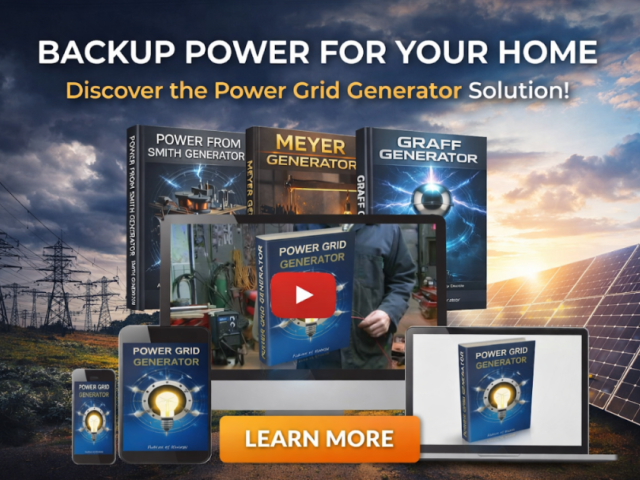
Power Grid Generator is a $49 digital DIY guide sold through ClickBank — a PDF and video blueprint showing you how to build a small power device from roughly $50–$110 of hardware-store parts. It is not a physical generator. Nothing ships to your house.
The marketing claims are substantial: cut electricity bills by up to 80%, works day and night with no fuel and no solar panels, buildable in a couple of hours, "inspired by Nikola Tesla's principles of energy recovery."
This review covers what you actually receive, what the physics says about those claims, the electrical safety issues nobody selling this mentions, the refund policy, and what genuinely works for home backup power instead.
The short version: it's a real product with a real refund policy, sold on a claim that cannot be true.
👉See the full product details and what's included »

⚠️ The Physics Problem
This has to come first, because everything else depends on it.
Energy cannot be created. That's the first law of thermodynamics, and it's not a guideline or a contested theory — it's the most thoroughly verified principle in physics. Any device that produces electricity must take energy from somewhere: fuel, sunlight, wind, moving water, a temperature difference, or stored charge in a battery.
Now look at what's being claimed:
-
No fuel — rules out combustion
-
No solar panels — rules out sunlight
-
Works day and night — rules out solar again, and daytime-dependent sources
-
No noise — rules out most mechanical generation
-
Compact, built from cheap parts — rules out wind or hydro at meaningful scale
So where is the energy supposed to come from? The marketing doesn't say, because there isn't an answer. A device that produces meaningful household electricity from nothing would be the most important invention in human history. It would not be sold as a $49 PDF.
About "Tesla-inspired energy recovery"
Nikola Tesla was a genuine and important engineer. Alternating current, the induction motor, and polyphase power systems are real contributions that underpin the modern grid.
But "Tesla's suppressed free energy secret" is one of the oldest tropes in online product marketing. It works because Tesla is famous, died without great wealth, and worked on wireless power transmission — which creates space for a story about hidden knowledge the power companies buried.
Tesla never built a device that created energy from nothing. Nothing in his actual published work suggests it's possible, because it isn't.
"Energy recovery" is a real engineering term — it describes capturing waste energy that would otherwise be lost, like regenerative braking in a car or heat recovery in HVAC. But recovery means you need a substantial energy flow to recover from. It never produces more than went in, and in a typical home there's no large waste-energy stream sitting around for a small homemade coil device to harvest.
What a cheap DIY device could actually do
To be fair rather than dismissive, here's what's genuinely possible with hardware-store parts:
-
Thermoelectric (Seebeck) generators convert a temperature difference into electricity. Real technology — but efficiency is low single digits, and you'd need a large, sustained heat source. A camping stove version might charge a phone slowly.
-
Ambient RF harvesting captures radio waves from broadcast towers. Real, and it produces microwatts — enough for a tiny sensor, not a millionth of what a refrigerator needs.
-
A small solar panel or hand-crank generator works fine, but both are excluded by the marketing.
For scale: a refrigerator uses roughly 100–200 watts continuously. A typical US home uses around 30 kilowatt-hours a day. Cutting that by 80% would require producing roughly 24 kWh daily from a compact homemade device with no fuel input. That is not a matter of build quality or technique — it's a matter of physics.

⚠️ The Electrical Safety Problem
This concerns me more than the money, and it's the part no review of this product seems to mention.
Several versions of the sales material discuss integrating the device with your home's electrical system to reduce what you draw from the utility. Please don't do that.
Backfeeding can kill someone. When any power source is connected to household wiring without a properly installed transfer switch, it can send electricity backward through your meter into the utility lines. Linemen working on what they believe is a dead circuit have been seriously injured and killed this way. This is why transfer switches are legally required for generator hookups, and why utilities warn about it after every major storm.
Other real risks:
-
Fire. Improper wiring, undersized conductors, and poor connections cause house fires. Electrical faults are a leading cause of residential fires.
-
Electrocution. Mains voltage kills. So do charged capacitors, which can hold a lethal charge long after a device is unplugged.
-
Insurance. Unpermitted electrical work can void your homeowner's policy. If a fire is traced to a DIY modification, your claim may be denied.
-
Code violations. Most jurisdictions require permits and inspection for electrical work. Unpermitted work can also create problems when you sell your home.
-
Battery hazards. If the build involves lithium batteries, improper charging or wiring creates fire and explosion risk.
The safe line: powering small devices from an isolated, self-contained battery setup through a proper outlet is very different from connecting anything to your house circuits. If you build anything from a guide like this, keep it entirely separate from your home wiring, and if you want backup power tied into your house, hire a licensed electrician. That's not excessive caution — it's the difference between a hobby project and a hazard.
What Is Power Grid Generator, Actually?
Setting the claims aside, here's what you receive:
You download blueprints, a parts list, circuit schematics, and step-by-step build instructions. You buy the components at a hardware store. You assemble it yourself.
Notably, the product's own positioning has softened over time. Some official materials now describe it as an "informational DIY guide" and an "educational instructional system, not a certified appliance or a guaranteed bill-reduction service," with results depending on "build quality" and "consistent application of the guide instructions."
That's a meaningful gap from "slash your power bills by up to 80%." When a product's fine print describes it as an unassessed educational experiment while the headline promises 80% savings, the fine print is the more accurate document.
👉See what's actually included and the current refund terms »
Does It Work? What Buyers Report
What supportive reviewers say
-
The guide is readable and the instructions are followable for someone comfortable with basic DIY
-
The parts are genuinely cheap and available at ordinary hardware stores
-
Educational value — some buyers say they learned basic electrical concepts
-
It's a weekend project — enjoyable for people who like building things
-
Small-scale charging — a few report powering small devices or charging a phone
Note that last point carefully. Charging a phone is not the same as reducing a household electricity bill. A phone charger draws about 5 watts. Your home draws thousands.
Common complaints
-
"It didn't reduce my bill at all." The most frequent complaint, and the predictable one.
-
"The output is negligible." Buyers who completed the build report small or unmeasurable power output.
-
Parts cost more than expected once you total everything.
-
Instructions assume more skill than advertised, despite "no advanced skills required."
-
The claims don't match the deliverable — this is the core of most negative feedback.
-
Safety concerns from buyers with electrical knowledge who looked at the schematics.
-
Refund friction — reports vary, though ClickBank's policy is generally reliable.

On the testimonials and review counts
Sales pages for this product show enthusiastic testimonials and impressive-sounding ratings without linked third-party verification. The most telling detail: none of the positive testimonials includes a before-and-after utility bill, which would be the single easiest way to prove the central claim.
If a device genuinely cut electricity bills by 80%, demonstrating it would be trivially easy — two utility statements. The absence of that evidence, across all the marketing, is itself informative.
Is Power Grid Generator a Scam?
Worth being precise, because "scam" and "doesn't work" are different accusations.
Is it fraud in the sense of taking your money and delivering nothing? No. You pay $49, you receive the digital guide immediately, and ClickBank's 60-day refund policy is reliably enforced as a platform-level protection. That's a genuine consumer safeguard.
Do the claims hold up? No. The central promise — meaningful electricity generation with no energy input — is physically impossible. No build quality or technique overcomes that.
The accurate description: a legitimately delivered, refundable $49 information product sold on a claim that cannot be true, with the added problem that acting on parts of it could be dangerous.
So: legitimate as a transaction. Not legitimate as advertised.
That distinction matters because the refund policy means your financial risk is genuinely limited. Your physical risk, if you wire something into your house, is not.
👉Check the current price and 60-day ClickBank refund policy »
Pros & Cons
Pros
-
$49 one-time — genuinely low financial exposure
-
60-day ClickBank guarantee, reliably enforced at platform level
-
Instant digital delivery, no shipping
-
Parts are inexpensive and widely available
-
Some educational value for DIY-curious beginners
-
No subscription or recurring charges
Cons
-
⚠️ The central claim violates the first law of thermodynamics
-
⚠️ Home wiring integration is genuinely dangerous — backfeed, fire, electrocution
-
⚠️ Insurance and electrical code implications for unpermitted work
-
No before-and-after utility bills anywhere in the marketing
-
"Tesla energy recovery" is marketing language, not a mechanism
-
80% bill reduction is not achievable by any device of this description
-
Product's own fine print contradicts its headline claims
-
Parts cost is additional to the $49
-
"No skills required" overstates the accessibility
-
Output, where buyers report any, is negligible relative to household demand
Price and Refund Policy
$49 one-time, anchored against a claimed regular price of $149. Anchor pricing that's never actually charged isn't a discount — judge it on the $49.
Parts add another $50–$110, so realistic total exposure is around $100–$160.
The 60-day ClickBank guarantee is the genuinely good part of this offer. ClickBank enforces refunds as a platform policy, which means you're not relying on the vendor's goodwill. If you buy and the device doesn't do what was promised, you can get the $49 back.
You cannot get the parts money back, which is worth factoring in before you start buying components.
Practical notes:
-
ClickBank is the retailer — a standard affiliate-marketplace arrangement. Their role doesn't constitute endorsement or review of the product's claims.
-
Keep your order receipt for the refund process.
-
Request the refund before buying parts if the guide doesn't convince you on reading.
-
Ignore countdown timers and "limited availability" — it's a digital download; there's no inventory.
What Actually Works for Home Backup Power
This is the genuinely useful part, because the underlying need — power during outages, lower bills — is real and there are real solutions.
For backup power during outages
Portable power stations (EcoFlow, Jackery, Bluetti, Anker and similar). These are UL-listed, safe, and actually work. A 1,000Wh unit runs a fridge for several hours, keeps phones and medical devices going, and powers lights. Entry models start around $200–$300; larger units run $700–$1,500. They can be recharged from wall power, a car, or solar panels.
For most households, this is the honest answer to "I want backup power without spending thousands."
Standby generators with a transfer switch — professionally installed, whole-home capable, $3,000–$10,000+. The transfer switch is the critical safety component that prevents backfeed.
Portable gas generators — $400–$1,500. Run them outdoors only, never in a garage or near windows. Carbon monoxide from generators kills people after every major storm. Use heavy-duty extension cords to appliances; never plug one into a wall outlet to "power the house."
Solar plus battery — genuine energy independence, $10,000–$30,000 installed, with meaningful tax credits available in many jurisdictions.
For actually reducing your electricity bill
The unglamorous list, in rough order of return:
-
Insulation and air sealing — usually the highest-return home energy investment
-
Heat pump water heater or HVAC upgrade — significant reduction for the largest loads
-
LED lighting throughout — cheap, immediate
-
Smart thermostat — a few degrees of setback saves real money
-
Time-of-use shifting — run dishwasher and laundry off-peak if your utility has rate tiers
-
Phantom load reduction — power strips on entertainment centers and office equipment
-
A free energy audit — many utilities offer these, and some offer rebates for the improvements
-
Rooftop solar — a genuine 50–90% bill reduction is achievable here, but it costs thousands, not $160
That last line is worth sitting with. Real solar — panels, inverter, professional installation — is the technology that actually delivers the savings this product promises. It works because sunlight is a genuine energy input. It costs what it costs because that's what the physics requires.
👉See the full product details and what's included »

Frequently Asked Questions
What is Power Grid Generator?
A $49 digital DIY guide — PDF and video — showing how to build a small power device from about $50–$110 of hardware-store parts. It's an information product; nothing physical ships.
Does Power Grid Generator work?
Not as advertised. A device producing meaningful electricity with no fuel, no sunlight, and no other energy input is not physically possible. Buyers who complete the build report negligible output.
Is it a scam?
Not in the fraud sense — you receive the guide and ClickBank's 60-day refund is reliably enforced. But the headline claims cannot be true, and the product's own fine print describes it as an educational guide rather than a bill-reduction solution.
Can it really cut my bill by 80%?
No. That would require generating roughly 24 kWh daily from a compact device with no energy input. Rooftop solar achieves reductions like that because sunlight is a real energy source; this isn't comparable.
Is it safe to build?
Building a small isolated device is generally low-risk if you're careful. Connecting anything to your home's electrical system is not — backfeed can electrocute utility workers, and DIY mains work causes fires. Hire a licensed electrician for anything touching house wiring.
What's the "Tesla energy recovery" principle?
Marketing language. Tesla's real contributions were to AC power systems. He never built a device creating energy from nothing, and "suppressed Tesla free energy" is a long-standing product-marketing trope.
How much does it cost in total?
$49 for the guide plus roughly $50–$110 in parts — around $100–$160 total. Only the $49 is refundable.
What's the refund policy?
60-day money-back guarantee via ClickBank, enforced at platform level. Keep your receipt.
What should I buy instead for backup power?
A UL-listed portable power station is the practical answer for most households — genuinely safe, genuinely works, starting around $200–$300.
Final Verdict: Is It Worth It?
No — not as a power solution. The central claim is physically impossible, and the part of it that could work is the part that could hurt you.
Let me be fair about what's genuinely true. It's a real product with real delivery and a real, enforceable 60-day refund through ClickBank. At $49, the financial risk is genuinely small. Some buyers find the guide readable and enjoy it as a weekend project, and there's some educational value in learning basic electrical concepts.
But the core promise — meaningful household electricity from a compact device with no fuel, no sunlight, day or night — cannot be delivered by any product, at any price, by anyone. That's not a criticism of this particular guide's quality. It's physics. The absence of a single before-and-after utility bill anywhere in the marketing tells you what the vendor knows about that.
And the safety dimension makes this different from an ordinary overhyped product. Wiring an untested homemade device into your house can cause fires, electrocute you, and endanger utility linemen through backfeed. No $49 PDF should be the basis for electrical work on your home.
If you buy it anyway: treat it as a hobby purchase, not an energy solution. Build nothing that connects to your home wiring. Keep any project entirely isolated and low-voltage. And request your refund within the 60-day window if it doesn't deliver — before you spend money on parts.
What I'd genuinely recommend instead: if you want outage protection, a UL-listed portable power station in the $200–$300 range will keep your fridge, phones, and lights running safely — and it actually works. If you want lower bills, book a free energy audit through your utility, then address insulation and your largest appliances. Those are the boring answers, and they're the ones that deliver what this product promises.
👉Check Power Grid Generator's current price and refund terms »
This article is for general informational purposes only and is not professional electrical advice. Electrical work on home systems should be performed by a licensed electrician and may require permits and inspection. Connecting any power source to household wiring without a properly installed transfer switch can cause fire, electrocution, and injury to utility workers. Never operate fuel-burning generators indoors or in enclosed spaces. Claims of electricity generation without an energy input are not supported by established physics.
Useful information
- Avoid scams by acting locally or paying with PayPal
- Never pay with Western Union, Moneygram or other anonymous payment services
- Don't buy or sell outside of your country. Don't accept cashier cheques from outside your country
- This site is never involved in any transaction, and does not handle payments, shipping, guarantee transactions, provide escrow services, or offer "buyer protection" or "seller certification"
Related listings
-
 Levium Honest Review: Does This Natural Stress Relief Supplement Really Work?Mood & Emotional Wellness - Cleveland (Ohio) - May 14, 2026 39.99 $
If you’ve been feeling overwhelmed, mentally exhausted, anxious, or emotionally drained from daily stress, you’re certainly not alone. The modern lifestyle places a relentless demand on the human nervous system. [>>Visit the o...
-
 The Last Wish Reviews Breakdown: Book & “Danny Kelly” Program—Worth It or Scam?Mood & Emotional Wellness - Adrian (Georgia) - May 10, 2026 37.44 $
If you have recently typed “The Last Wish reviews” into your search bar, you have almost certainly encountered a highly confusing wall of mixed results. You aren't alone. The internet is currently displaying reviews for three completely d...
-
 Soulmate Story Reviews Breakdown: Sketch, Drawing & Reading—Legit or Scam?Mood & Emotional Wellness - Charlotte (North Carolina) - May 10, 2026 Check with seller
If you have ever found yourself staring at the ceiling at 2 AM, wondering, “Who is my soulmate?” or “When will I finally meet the right person?” you are far from alone. In 2026, social media feeds are flooded with highly targe...